Plan Your Path – to be released February 2026
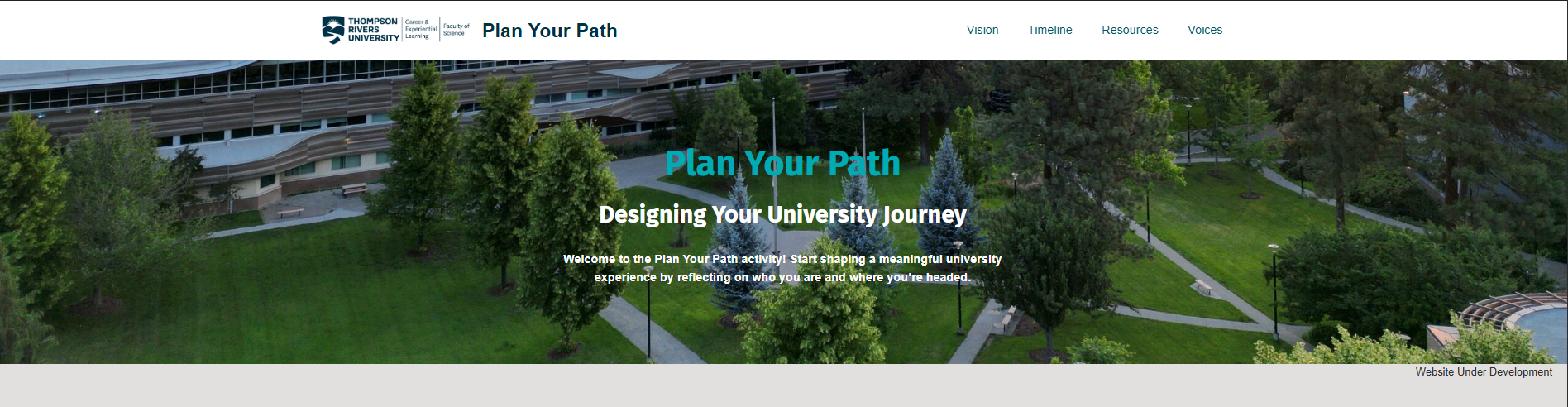
Faculty/Staff: Sarah Gibson and Lindsay Blackstock
Platform: WordPress
Site link (if applicable): https://planyourpath.trubox.ca
Services provided: Domain/ site set up and structure, video/ transcript production, creating forms (multiple formats), multimedia
Description: Plan your path is a thoughtfully developed Open Educational Resource (OER) designed to guide Thompson Rivers University students through their academic and personal development journey. This resource provides a structured degree timeline to help students map out their coursework, alongside reflective tools to envision who they want to become during their time at university. It encourages intentional goal-setting and personal growth, supporting students in building skills, habits, and a mindset that aligns with their aspirations. In addition to academic planning, Plan your path includes a curated collection of essential TRU resources, from academic support to wellness services; ensuring that students are aware of and can access the help they need throughout their university experience.
Impact Story
By Divya Chandak
Background
The Plan Your Path Open Educational Resource (OER) originated from a shared commitment to student success in professional and academic planning at Thompson Rivers University (TRU).At the heart of this initiative are: Sarah Gibson, Co-op Coordinator for Sciences and Arts and Lindsay Blackstock, Assistant Teaching Professor in the Faculty of Science
Sarah, co-op coordinator for sciences and arts, who has been at TRU since 2005, serving in various departments, including Open Learning and TRU World, and as an instructor.
Lindsay Blackstock, Assistant Teaching Professor in the Faculty of Science, who primarily teaches chemistry and coordinates the first-year science cohort program and the S.T.A.M.P. peer mentorship group.
The two connected over their mutual love for the co-op program and a shared idea that students often had a gap in recognizing the importance of goal-setting early in their undergraduate careers. This sparked a collaboration in the summer of 2023 to develop a planning tool and accompanying workshop for science students.
Inspiration and Idea
The initial idea for the planning tool came from a desire to create a science intervention workshop to support the career development of undergraduate science students. Lindsay, an alumni of the co-op program, and Sarah, the co-op coordinator, felt they were the “perfect match” to work together. The project gained momentum when the first-year science cohort program was established, providing a perfect initial target audience for the planning tool. Initially, the tool was a hard-copy, pen-to-paper resource used during a 2.5-hour workshop in the fall of 2023. However, their long-term goal was always to transition it into an online, Open Educational Resource.
“We had a longer term vision of it, but without the tremendous support of TRU Open Press and the amazing expertise on the team, that it wouldn’t have evolved the way it has,” – Sarah.
Collaboration and Support
Both Sarah and Lindsay had worked with TRU Open Press before and felt confident approaching them to make the project an OER. The collaboration was marked by trust, detailed communication, and a strong work ethic from the Open Press team.
The team, including co-op students, worked with incredible diligence to meet a tight deadline for disseminating the new resource at an international conference. This speedy turnaround, which saw a first draft produced in about a week, “blew them away”.
Working with Open Press allowed the creators, who manage “busy demanding roles,” to trust the team to move the project forward, overcoming the challenge of balancing multiple priorities. The final product, with its online and interactive design, even went beyond their expectations.
Challenges and Breakthroughs
The main challenge faced by Sarah and Lindsay was finding the time to dedicate to the project amidst their many other demanding roles. The breakthrough was the Open Press team’s ability to take the project on and move it forward, allowing the creators to check in as time allowed. This success was exemplified by the work of a co-op student named Samar, who created an innovative, embedded visualization for the tool. “Samar did it. He coded it. Right. He created a brand new thing that’s interactive for students and we challenged him, and he met that challenge,” Lindsay recalled. This student-driven creativity resulted in a final resource that offers multiple ways for students to visualize and interact with their path, depending on their preference.
Impact on Students and Educators
The OER was designed to help early undergraduate students set small, achievable, and relevant goals. However, its use quickly expanded when upper-level students found the tool equally helpful. This led to the evolution of the accompanying workshop from “Plan Your Path” (forward-thinking goal setting) to “Present Your Path” (a retrospective, reflective tool). The tool is now multifaceted, allowing students to:
- Plan forward for their future.
- Reflect and organize their professional and academic accomplishments.
- Prepare for professional school, grad school, or industry job applications.
Crucially, the resource emphasizes core lessons taught in cooperative education, but in an open and inclusive way that provides access to all students, regardless of their enrollment in the co-op program.
Looking Ahead
Both Sarah and Lindsay are strong advocates for the continued expansion of Open Education at TRU. Sarah has also been involved in other OER projects like the TRU Career & Experiential Learning career textbook and the TRU CEL Resume Catalog, resources that are openly accessible, aligning with TRU’s mission of being an open-access university.
Lindsay is seeing a shift in the Faculty of Science, with more instructors moving towards OERs, including a student-driven, formative self-assessment tool called PASSchem. They believe the future of OER is exciting, especially with the use of new technology, and is essential for lowering barriers and increasing access for students.
Advice for Future Creators
Their advice for those considering creating an OER is both practical and encouraging: Be comfortable with imperfection. Open works are iterative, and you can always improve upon them. Just start and meet yourself where you’re at. Be flexible and open with how the final product will look, as being too rigid can create unnecessary boundaries for the Open Press team. Do it! If you have an idea, pursue it, as the TRU Open Press team is incredibly supportive and the process can be fun. Ask for help.