Knowledge Makers Volume Nine (2024) and Volume 10 (2025)
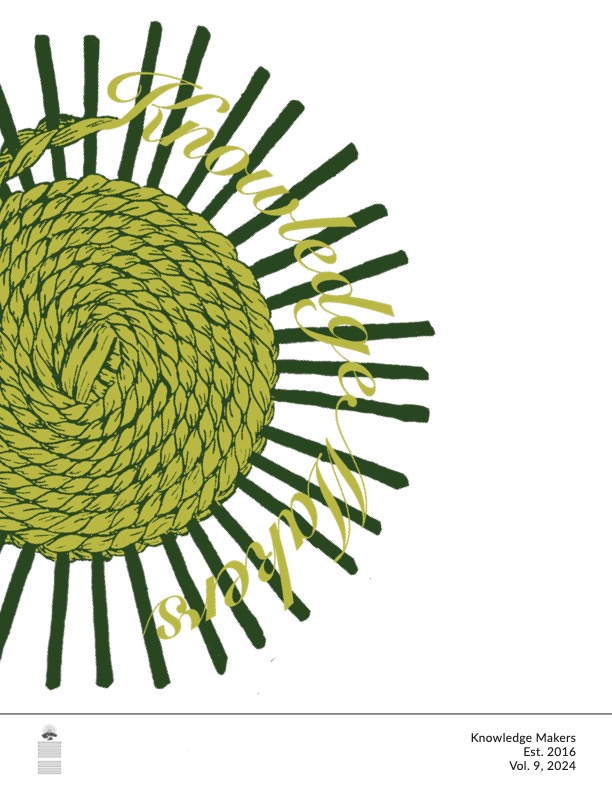
Faculty/Staff: Chuying Jiao and Jeneen Herns-Jensen
Platform: WordPress
Site link (if applicable): https://knowledgemakers.trubox.ca/knowledge-makers/the-journal/volumes/
Services provided: Design and development of journal layout
Description: As of 2023, Knowledge Makers has featured over 100 undergraduates, 50 Graduates and Knowledge Makers alumni, and 15 Elders and Faculty. The papers in each volume vary and have covered topics across the whole range of academia. This includes topics from fine arts to education to physics, and every year we hope to include even more topics and voices in our research network. With each volume of Knowledge Makers, we are not only able to connect and grow our network but also build something together that makes sharing and preserving knowledge possible. (https://knowledgemakers.trubox.ca)
Impact Story
Written by Divya Chandak
Background
For more than a decade, the Knowledge Makers program at Thompson Rivers University has supported Indigenous students in sharing their research and stories. At the heart of this initiative are Jeneen Herns-Jensen, Associate Director of the All My Relations Indigenous Research Centre, and Chuying Jiao, Research Associate and Program Coordinator for Knowledge Makers.
Jeneen, a mixed Indigenous-settler descendant, has spent years helping students develop research ideas from undergraduate to graduate levels. “We go through workshops and help them publish their research in a peer-reviewed, publishable format,” she explained. Working alongside her, Chuying oversees the program’s publication process, supporting students through workshops, editing, and design coordination. Together, they bring students’ voices to life through the Knowledge Makers journals.
Inspiration and Idea
The idea for collaborating with TRU Open Press on Knowledge Makers Volumes 9 & 10 emerged from a shared goal: creating an accessible, high-quality platform for Indigenous student research. “TRU is a leader in research,” Jeneen said, “and as a leader, we were excited for the opportunity to collaborate with on-campus resources.”
Before Open Press, the program relied on external designers, a process that was time-consuming and challenging. “We used to have one graphic designer for our past volumes,” recalled Chuying. “When that was no longer possible, I had to start learning InDesign from scratch through YouTube tutorials, it was really hard for a beginner.”
The launch of TRU Open Press provided the missing piece. “Once we heard the program was funded, we were so excited to finally have an on-campus, digital publishing format,” Jeneen said.
Collaboration and Support
Working with the TRU Open Press team, especially Jessica and Dani- transformed the publishing experience. “Everything turned out so fast,” Chuying shared. “All we had to do was collect the resources, send them over, and Jessica gave us amazing outcomes and feedback.”
The partnership was grounded in patience and flexibility, aligning perfectly with the program’s student-centered approach. “Indigenous research tends to happen on its own cycle,” Jeneen said. “We really appreciated TRU Open Press for being flexible with the students’ timelines.”
Chuying agreed, adding, “Students don’t always follow strict deadlines, and Jessica and Dani were so understanding. They truly supported us and respected the students’ realities.”
Challenges and Breakthroughs
While publishing student-led journals is rewarding, it comes with its own set of challenges. “The main challenge is always adapting to student timelines and needs,” Jeneen said. “But with Open Press, we developed a flexible framework that took away a lot of that pressure.”
The collaboration also required quick turnarounds. “The deadlines between submission and publication were sometimes really tight,” Chuying recalled. “Jessica worked incredibly hard to make it happen, and we spoke almost every day while making small design changes.”
Despite the challenges, the result was worth it. “It’s amazing to see how responsive and student-centered Open Press is,” Chuying said. “They truly put effort into what they deliver to students.”
Impact on Students and Educators
At its core, Knowledge Makers is about empowering students to share their stories. “Our inspiration is always the students,” Jeneen said. “Each volume focuses on their experiences and ideas.” Volume 9 highlighted interdisciplinary research in science, technology, land, Indigenous rights, and identity, while Volume 10 explored global Indigenous solidarity through a more visual, fluid design.
The project also sparked meaningful outcomes beyond the journals. One student, Leticia, transformed her master’s research into a website sharing the stories of her Kikuyu community in Kenya- with guidance from Open Press.
“It was incredible to see the journal move beyond the printed page into a digital format that modernized and preserved community knowledge,”- Jeneen.
Another student, Dr. Bukola Osuntade, co-published a book with Dr. Alana Hoare through the same collaborative network. “Open Press provided a platform for both graduate and undergraduate students to publish and share their work,” Jeneen reflected.
Looking Ahead
Both Jeneen and Chuying see open education as a key part of TRU’s future. “I’m hopeful for the role of open education evolving at Thompson Rivers University,” Jeneen said. “It supports not only students, but also faculty and staff who are doing incredible, grassroots research.”
For Chuying, the value lies in accessibility: “It’s transformative- bridging traditional Indigenous knowledge with modern technology. Open Press makes that transition possible.”
Advice for Future Creators
Their advice to future OER creators is simple but powerful. “Think of your audience first,” Jeneen said. “Create a resource that’s practical, accessible, and truly valuable to the people who will use it.”Chuying added, “Be passionate about your project and never be afraid to ask for help. Many students have amazing ideas but think they lack resources- just reach out and connect.” Together, their story shows how collaboration, patience, and care can turn student research into lasting, open-access knowledge for the world.